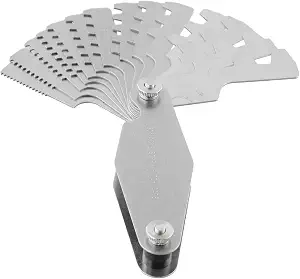
for acme Thread Pitch Gauge
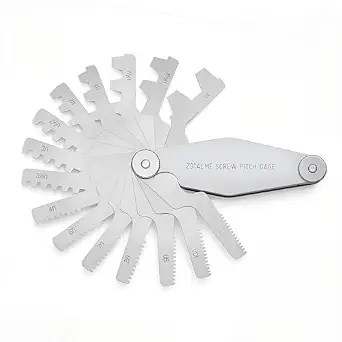
29 Degree Acme Screw Pitch Gauge Stainless T-Thread Cutting Tool Set 16pcs
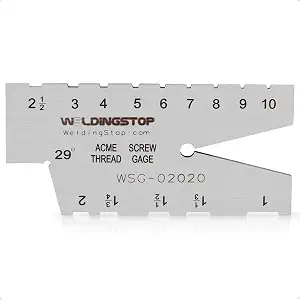
ACME SCREW THREAD GAUGE 29 DEGREE GRINDING GAGE TOOL
Best Acme Tool Buying Guide — Black Friday Deals 2026
Will the gauge you choose check the particular thread angle and pitch information your work calls for, or does its listing describe a different kind of coverage? That distinction matters when shopping for ACME thread gauges: the products here include a multi-blade gauge, a listed 16-piece set, and a single-piece tool, with different angle and coverage details. This guide compares those facts without treating the formats as interchangeable. For Black Friday, start by identifying the exact measurement or tool check you need, then compare it with the precise item and variant in the listing. A promotion is useful only if the product details match your intended task.
for acme Thread Pitch Gauge
Best Overall is the editorial pick for shoppers whose first priority is a clearly stated pitch range in a multi-blade format. The for acme Thread Pitch Gauge lists a 30° thread angle, a 2P to 20P pitch range, and a blade count described as “Fourteen for blades.” Its stated dimensions are 5.91 x 1.97 x 0.79 inches, and its material is listed as quenched stainless iron. Those details give you several concrete points to check against the measurement notes you already have. The label is a buyer-fit choice among these featured products, not a claim that the gauge has been tested or is best for every ACME task.
Consider this option if the work requirement is expressed as pitch within the listed range and the stated angle is appropriate for your purpose. The range description is not a substitute for checking the actual markings or confirming what your job requires; the product facts do not explain further measurement conventions. Likewise, the listed blade count tells you about the format, but does not establish which individual markings are included. If a particular pitch or angle is essential, compare those requirements with the exact product listing rather than assuming the headline description covers every need.
The dimensions may help you think about storage and handling in your own setup, but they do not establish how the gauge will fit in a particular case or feel in use. The material description is a specification, not a promise about durability, corrosion behavior, or service life. Those are sensible details to verify if they matter to your purchase. This is also a useful point to slow down during Black Friday: check that the offer is for this exact gauge and not another item with a similar ACME name. Do not let a deal label stand in for the stated 30° angle or 2P to 20P range.
The main tradeoff is that this listing gives a different set of coverage details from the 29-degree products below. That does not make it a substitute for either of them; it makes matching the stated angle especially important. If the 30° specification and described pitch range fit your requirements, this is the straightforward multi-blade candidate in this group. If your work calls for a listed 29-degree tool or specific inch thread sizes, compare the other entries instead. Before a Black Friday purchase, use the full product name and the listing’s precise specification details to confirm you have selected the intended item.
Key specs
| Thread angle | 30° |
| Pitch range | 2P to 20P |
| Blade count | Fourteen for blades |
| Material | quenched stainless iron |
| Dimensions | 5.91 x 1.97 x 0.79 inches |
29 Degree Acme Screw Pitch Gauge Stainless T-Thread Cutting Tool Set 16pcs
Check Price on Amazon
Best for Broad Listed Size Coverage is the editorial label for this stainless-steel, 16-piece 29 Degrees ACME Screw Pitch Gauge set. Its listing names thread sizes of 1, 1-1/3, 1-1/2, 1-3/4, 2, 2-1/2, 3, 3-1/2, 4, 5, 6, 7, 8, 9, 10, and 12 in. That explicit list gives a shopper a direct way to compare a required size with the product description. The label refers only to the breadth of the size entries provided here; it is not a tested performance claim or a statement about coverage beyond those entries.
The listing says the gauge measures internal and external screw threads with thread blades of varied size. That stated use may be relevant if your work involves checking both kinds of thread, but it does not establish suitability for every thread form or application. Begin by finding the required size in the actual listing and confirm that the 29-degree description aligns with your task. A long list can look reassuring, yet it is only useful when the exact size and angle you need are represented. If your requirement is not on the stated list, do not assume the set includes it.
The laser-engraved scale is described as not easy to wear and durable. Treat that as the listing’s marking description rather than a guarantee of lifespan or a substitute for checking legibility on the exact item. Stainless steel is the stated material; no further performance claims should be inferred from that alone. As you compare the set with the single-piece gauge, consider whether the listed set contents and size entries are useful for your work, rather than assuming more pieces automatically mean a better match.
For Black Friday, verify the offer is specifically for the 16-piece set and read the item’s stated angle and size list before making a decision. Similar product titles can make it easy to overlook which format is in the cart. Compare the exact offer and selected variant with your written requirements; do not assume that a promotion changes what sizes are included. This set is a logical candidate when several of its listed size entries are relevant, while a more focused need may call for a different format. Its editorial label highlights the provided list, not a verified advantage over every alternative.
Key specs
| Set contents | 29 Degrees ACME Screw Pitch Gauge 16 pcs set |
| Thread sizes | 1, 1-1/3, 1-1/2, 1-3/4, 2, 2-1/2, 3, 3-1/2, 4, 5, 6, 7, 8, 9, 10, 12 in |
| Material | The Screw Thread Pitch gage is made of stainless steel |
| Measurement | Measures internal and external screw threads with thread blades of varied size |
| Scale | Laser engraved scale is not easy to wearand durable |
ACME SCREW THREAD GAUGE 29 DEGREE GRINDING GAGE TOOL
Check Price on Amazon
Best Budget is the editorial choice for shoppers who want to consider a single-piece 29-degree gauge rather than begin with a set. The ACME SCREW THREAD GAUGE 29 DEGREE GRINDING GAGE TOOL is described as a single piece made of stainless steel. Its listed range is 1-10TPI, and its pitch entries are 1, 1-1/3, 1-1/2, 1-3/4, 2, 2-1/2, 3, 4, 5, 6, 7, 8, 9, and 10. The product facts also state that it measures thread and external thread tooth pitch and is a standard gauge for checking the angle of screw cutting tools.
The label is an editorial fit, not a claim that this item has a lower price, a discount, or measured value. Its single-piece format is the main distinction shoppers can assess from the provided information. If the tool-check purpose and listed pitch entries correspond to your task, this may be a more direct candidate than a set whose listed sizes you do not need. If you are considering it for thread measurement, read the stated use carefully: the description names thread and external thread tooth pitch, while the other set explicitly describes internal and external screw threads.
All scales are described as laser engraving. That marking detail can help you understand what the listing specifies, but it does not prove a particular level of legibility or durability in your working conditions. The stainless-steel description is similarly limited to the named material. Avoid treating either detail as a guarantee. For a requirement stated in TPI, compare it with the stated 1-10TPI range and the individual pitch entries rather than relying on the product title alone.
A Black Friday promotion does not resolve whether a single piece or multi-piece option is the right fit. Confirm that the exact listing is for this 29-degree single-piece tool, then check its range, pitch entries, and stated tool-check use. If a listed entry is missing from the product facts or your required angle differs, pause and verify the item details before ordering. The Best Budget designation simply helps identify a focused format among these three choices; it is not evidence of sale pricing, savings, or tested performance.
Key specs
| Type | The 29 degree stainless steel acme thread gauge is a single piece type |
| Use | it is applied to measure thread and external thread tooth pitch. |
| Range | The acme thread gauge range:1-10TPI |
| Pitch | the pitch:1,1-1/3,1-1/2,1-3/4,2,2-1/2,3,4,5,6,7,8,9,10. |
| Tool check | Standard gauge for check the angle of screw cutting tools |
| Scale marking | All the scales on the acme screw gauge are laser engraving |
Write down the requirement before browsing
A useful shortlist begins with the notation on the part, drawing, or work instruction—not the product title. Record the angle you need, the pitch or size information you need to check, and whether the task concerns a thread, an external thread, or a screw-cutting tool. Then separate requirements that must match from details that are merely convenient. This makes it easier to notice that the featured gauges do not all state the same angle or describe coverage in the same way.
The for acme gauge lists 30° and a 2P to 20P pitch range. The 16-piece set is described as a 29 Degrees gauge and provides a list of inch thread sizes. The single-piece grinding gauge also states 29 degree and supplies a 1-10TPI range with individual pitch entries. These descriptions should be read as separate specifications, not converted into one another or presumed equivalent. The supplied product information does not explain every notation convention, so if your work uses a particular standard or interpretation, confirm it through the exact listing or your work documentation.
For Black Friday, put these requirements in a short checklist before opening promotional pages. A discount banner cannot establish that the angle, size, or intended check matches your task. Keeping the job requirement visible helps you compare the actual product details, even when listings use similar ACME wording. If you cannot confirm a required detail from the provided description, treat that as a question to resolve—not as a reason to assume the product will cover it.
Interpret angle and coverage as separate filters
Angle and coverage answer different shopping questions. An angle specification helps you identify whether the product description aligns with the angle required for your work. A pitch range or size list tells you which coverage information the listing provides. A match on one point does not automatically confirm a match on the other. Keeping these checks separate reduces the chance of selecting a gauge because its range looks useful while overlooking a stated angle that does not suit the requirement.
Among these options, two listings specify 29 degree or 29 Degrees, while the for acme Thread Pitch Gauge lists 30°. The former should not be casually treated as the latter. Separately, the multi-blade gauge gives a 2P to 20P range; the 16-piece set lists individual inch sizes; and the single-piece tool gives a 1-10TPI range alongside pitch entries. These formats present coverage differently, so compare the precise wording against the notation on your job rather than trying to rank them by a single number.
During Black Friday, check the angle and the coverage details on the exact item page, then confirm the selected product name and variant before completing a purchase. If your task calls for a specific entry, look for that entry rather than relying on a general claim such as broad coverage. This careful separation is especially useful when browsing results that share similar terms. The goal is not to make one format fit every task; it is to rule out mismatches before a promotional offer distracts from the specifications.
Choose a format around the actual check
A multi-blade gauge, a listed set, and a single-piece gauge invite different practical questions. With the for acme gauge, the listing identifies a blade count of “Fourteen for blades,” a stated pitch range, and dimensions. With the 16-piece set, the key information is the set description and its individual size list. The remaining product is explicitly described as a single-piece type, with listed pitch entries and a screw-cutting-tool angle check. Those are the distinctions supported by the product information; they do not establish how quickly any item can be used or how it will feel in a particular routine.
Think through the sequence of checks you actually perform. If you need to compare a particular entry, identify which listing names it. If you want to measure internal and external screw threads, the 16-piece set explicitly states both uses. If checking the angle of screw cutting tools is central, the single-piece gauge’s stated purpose may be relevant. The multi-blade option gives its own angle, pitch range, count, material, and dimensions. Each description points to a different way to narrow the choice, but none should be assumed to cover a task its facts do not mention.
A Black Friday listing may emphasize a product title or package image, so read the written format and contents as well. Do not assume that a pictured item, a similar name, or a promotional badge tells you which coverage is included. Match the task first, then decide whether the stated format makes sense for how you plan to check it. That approach keeps the decision practical without claiming unsupported advantages for a set or single piece.
Use material and marking details within their limits
Material and marking statements are useful listing details, but they should not carry more weight than their wording supports. The for acme gauge is described as quenched stainless iron. The 16-piece set and the single-piece gauge are each described as stainless steel. These are the material descriptions provided; they do not establish a service life, resistance to a particular environment, or comparative durability. If a specific working condition makes material critical, verify that the exact item’s full listing answers the question.
The 16-piece set says its scale is laser engraved and describes it as not easy to wear and durable. The single-piece gauge says all of its scales are laser engraving. The first listing includes a durability characterization, but neither description justifies a broader promise about performance in every setting. The for acme gauge’s supplied facts do not specify a marking method, which should not be read as proof that a marking feature is absent. Compare only what each listing actually states.
When shopping Black Friday, do not let a material or engraving phrase replace the angle and coverage check. You can note these details if they matter to your preference, then return to the task requirements and exact product variant. If the listing uses wording that is important but unclear, resolve it before purchasing. This keeps the comparison grounded in the available descriptions and avoids turning a narrow specification into a guarantee that the source information does not provide.
Make the Black Friday comparison item-specific
A promotion is not itself a product specification. Compare the exact item shown in the offer with the product you intend to buy, and check that the name, format, angle, and listed coverage still correspond to your notes. The provided information does not establish sale prices, discounts, availability, or whether a particular listing will be promoted. Treat any offer details you encounter as something to verify on the live listing rather than assuming a deal applies to the gauge discussed here.
Keep the three formats distinct while you browse: one description gives a multi-blade gauge with a stated range and dimensions; another describes a 16-piece, 29 Degrees set with a list of inch sizes; the third identifies a single-piece, 29-degree tool with its own range, pitch entries, and stated purpose. Similar wording in a search result can obscure these differences. Open the exact item and check its specifications and selected variant, especially if the page presents multiple choices.
Before completing a Black Friday order, ask whether the stated angle is the one you need, whether your required pitch or size appears in the product facts, and whether the described use matches your intended check. If one answer is unclear, pause instead of filling in the gap with assumptions. The same checklist works whether the offer is compelling or not: a promotion only helps when it applies to the exact configuration that meets your needs.
Make your Black Friday choice
The safest choice is the one whose stated angle, coverage, and format line up with the job you have in mind. Compare the multi-blade gauge’s 30° description and 2P to 20P range with the two 29-degree options, then distinguish the 16-piece set’s listed sizes from the single-piece tool’s range, pitch entries, and stated tool-check purpose. For Black Friday, confirm the exact listing and selected variant; do not infer a discount or missing specification. A brief checklist of required angle, measurement notation, size, and use can turn three similar-sounding ACME listings into a more deliberate decision.