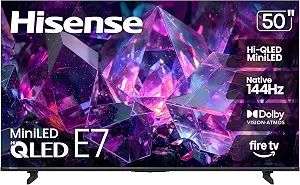
Hisense 50" E7 Cinema Series Hi-QLED Mini-LED 4K UHD Smart Fire TV (50E7SF)
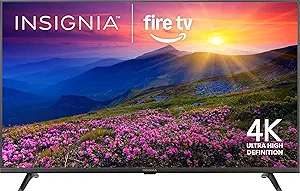
INSIGNIA 50" Class F50 Series LED 4K UHD Smart Fire TV with Alexa Voice Remote (NS-50F502NA26)
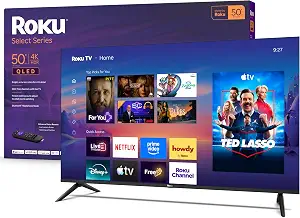
Roku 50-Inch Select Series Smart TV 2026-4K (2160p) QLED TV
Best Size50Inch Tv Buying Guide — Black Friday Deals 2026
A 50-inch TV shortlist can look deceptively simple: all three options here are 4K, yet they differ in refresh rate, display terminology, operating system, and connections. Those distinctions help narrow the choice when you decide what the screen needs to do in your home. One model lists Mini-LED and a 144 hertz refresh rate; another keeps the specification set straightforward with HDR10 and Fire TV; the Roku option gives its interface a central role. For Black Friday, treat each offer as a model-matching exercise, not a reason to assume every listing or variant is identical. Start with your viewing priorities, then check which listed details support them.
Hisense 50" E7 Cinema Series Hi-QLED Mini-LED 4K UHD Smart Fire TV (50E7SF)
Check Price on Amazon
The Hisense is the Best Overall choice among these three when you want a 50-inch 4K screen with a particularly broad set of listed display and setup details to weigh. Its specifications include Mini-LED backlighting and a 144 hertz refresh rate. Those are useful points of distinction for shoppers comparing display configurations, but they do not by themselves promise a particular viewing result. Consider whether those named characteristics are priorities for your room and the kinds of content you expect to watch before letting them decide the shortlist.
Its four HDMI ports may be relevant if your intended arrangement calls for several HDMI-connected devices. Think through what you actually plan to connect, rather than treating a port count as a reason to buy more television than your setup needs. FireOS is the listed operating system, while AirPlay is the screen-mirroring technology. Those details offer practical checkpoints for people who want to consider interface and mirroring alongside picture specifications. The listed speaker maximum output power is 20 watts; decide whether that specification fits the role you have in mind for the TV, without assuming a listening experience from the number alone.
For Black Friday, this is a strong shortlist candidate if Mini-LED, the stated refresh rate, and the connection count matter to your decision together. It may be less compelling for someone who would rather prioritize a familiar interface or a simpler comparison than focus on those display distinctions. Check the exact offer for the 50E7SF model and confirm that the listing describes the configuration you intend to buy. The Best Overall label is an editorial choice within this group, not a claim that it wins every use case: the best fit still depends on which listed features solve a real need in your household.
Key specs
| Screen size | Screen Size 50 inches |
| Resolution | Resolution 4K |
| Refresh rate | Refresh Rate 144 hertz |
| Backlight | Display Backlight Technology Mini-LED |
| HDMI ports | Total Number of HDMI Ports 4 |
| Operating system | Operating System FireOS |
| Audio output | Speaker Maximum Output Power 20 watts |
| Screen mirroring | Screen Mirroring Technology AirPlay |
INSIGNIA 50" Class F50 Series LED 4K UHD Smart Fire TV with Alexa Voice Remote (NS-50F502NA26)
Check Price on Amazon
The INSIGNIA earns the Best Budget label as an editorial pick for shoppers who want a clear, compact set of specifications to compare while considering a 50-inch 4K Fire TV. That label does not assert a price, discount, or market-wide value ranking. Its listed refresh rate is 60 hertz, and its supported HDR format is HDR10. If those are the picture details you want to evaluate, they provide a direct starting point; if a different refresh-rate specification is central to your decision, compare the options on that basis instead of assuming that all 4K models share the same configuration.
FireOS gives this model a straightforward point of comparison for households considering the same operating system across a shortlist. It has three HDMI ports, so count the connections your planned arrangement requires and consider whether that number suits it. Bluetooth and Wi-Fi are the listed wireless technologies. These are concrete details to check against your intended setup, not a promise about support for any particular device or service. The model name also includes an Alexa Voice Remote, but the provided specifications do not establish other remote functions, so keep your comparison tied to the named product and listing.
During Black Friday, compare the precise NS-50F502NA26 identity and its listed configuration before judging an offer. The TV may suit someone who places more weight on 4K resolution, HDR10, and FireOS than on the Hisense model’s stated refresh rate or Mini-LED backlighting. Its Best Budget label is meant to help orient the comparison, not to imply that it has the lowest live price. Check the offer itself and decide whether its refresh rate, three HDMI ports, and wireless specifications match your own requirements. A model that aligns with those needs is a more useful choice than a seasonal headline that does not.
Key specs
| Resolution | Resolution 4K |
| Refresh rate | Refresh Rate 60 hertz |
| HDR format | HDR Format Supported HDR10 |
| Operating system | Operating System FireOS |
| HDMI ports | Total Number of HDMI Ports 3 |
| Screen size | Screen Size 50 inches |
| Wireless technology | Wireless Technology Bluetooth, Wi-Fi |
Roku 50-Inch Select Series Smart TV 2026-4K (2160p) QLED TV
Check Price on Amazon
The Roku 50-Inch Select Series is Best for Roku OS shoppers, an editorial label grounded in its listed operating system rather than a claim about performance or popularity. Its 50-inch screen has 4K resolution and a 60 hertz refresh rate. The product name identifies it as a QLED TV, which gives shoppers another model descriptor to consider, while the provided specifications do not establish additional display results. If you already want to compare a Roku OS television, this option lets you keep that preference central instead of selecting solely by resolution.
Four HDMI ports provide a concrete point for planning a setup with HDMI-connected equipment: count the devices you expect to use and decide whether the listed total fits your plan. Bluetooth and Wi-Fi are the listed wireless technologies. The model also gives a VESA mount standard of 200 x 100 mm, a useful detail to check against a mounting plan. Confirm that the exact mounting arrangement you have in mind is appropriate rather than assuming that a listed standard resolves every installation question. These details make the product relevant to shoppers balancing interface choice with connection and placement considerations.
For Black Friday, this model is worth comparing when Roku OS is a deliberate preference and the connection details matter to your arrangement. Its 60 hertz refresh rate is the same listed rate as the INSIGNIA, while both present 4K resolution; the distinguishing considerations include their operating systems and other listed details. Do not treat the QLED name as a substitute for checking the exact model, or assume an offer refers to the same configuration just because the screen size matches. The right decision is the listing that matches your interface preference, connections, and mounting plan—not a label interpreted as a guarantee of superiority.
Key specs
| Resolution | Resolution 4K |
| Refresh rate | Refresh Rate 60 hertz |
| Screen size | Screen Size 50 inches |
| HDMI ports | Total Number of HDMI Ports 4 |
| Operating system | Operating System Roku OS |
| Wireless connectivity | Wireless Technology Bluetooth, Wi-Fi |
| VESA mount | VESA Mount Standard 200 x 100 mm |
Decide what counts as a meaningful picture difference
All three options list 4K resolution, so resolution alone will not separate this shortlist. Look next at the other display-related details that are actually provided. The Hisense lists Mini-LED backlighting and a 144 hertz refresh rate. The INSIGNIA lists a 60 hertz refresh rate and HDR10 support. The Roku model lists a 60 hertz refresh rate and is identified as QLED in its name. These are different kinds of details, not interchangeable measures; do not turn them into an unsupported prediction about how any particular program will look.
Make a personal priority list before Black Friday offers compete for your attention. You might want a particular refresh-rate specification, or you might care more about comparing the named display technologies and HDR format. If you cannot identify a practical reason to favor one detail, avoid treating it as decisive just because it sounds prominent. Keep the viewing situation in mind, but rely on the facts provided for each specific model. That approach helps prevent a shared 4K label from hiding differences—or a technical term from making a choice for you.
Let the interface influence the shortlist
An operating system is part of the everyday product choice, so decide which listed interface you want to evaluate before narrowing the models. The Hisense and INSIGNIA specify FireOS; the Roku option specifies Roku OS. If one of these is your preference, that can eliminate a mismatch early. If you are undecided, compare the systems as a household decision and avoid assuming features or services that are not stated in the product facts. The goal is to choose a model whose listed interface fits your priorities, not to infer an experience from its name.
Black Friday can make interface preferences easy to overlook when offer language emphasizes a different feature. Bring the operating system back into the comparison, especially if several people will use the television. Also note that the Hisense lists AirPlay screen mirroring, while the INSIGNIA and Roku product facts list Bluetooth and Wi-Fi wireless technology. These details are not identical categories, so compare them only in relation to what you need. Do not assume a particular device will connect or that an unlisted capability is unavailable; verify the exact listing if compatibility is essential.
Count the connections your arrangement calls for
A port count is most useful when you connect it to a real setup. The Hisense and Roku models each list four HDMI ports, while the INSIGNIA lists three. Write down the HDMI equipment you expect to attach and compare that plan with the listed total. If the count is not a constraint for you, it should not outweigh more relevant priorities such as the operating system or display details. If it is important, use the distinction as a practical way to reduce the shortlist rather than assuming that a larger number automatically makes one model a better fit.
Think about placement at the same time, but keep the evidence specific. The Roku model lists a VESA mount standard of 200 x 100 mm. Check that detail against your intended mounting arrangement and confirm any additional requirements using the exact product information before purchasing. The provided facts do not give placement measurements for the other two models, so do not fill that gap with assumptions. For a Black Friday decision, knowing which connection count or mounting detail you need can make model comparisons more useful than reacting to a general promotion.
Separate a useful label from a proven value
The editorial labels here are ways to navigate this particular group: Best Overall for the Hisense, Best Budget for the INSIGNIA, and Best for Roku OS shoppers for the Roku model. They do not establish measured superiority, price position, or a broader market ranking. Use each label as a prompt to inspect the underlying facts. For example, the Best Budget choice still needs to match your priorities for FireOS, HDR10, refresh rate, and three HDMI ports; its label does not tell you what an offer costs.
During Black Friday, compare the exact model identity and configuration rather than letting a badge or seasonal phrasing stand in for product details. Check whether the listing is for the model you intended to consider, then weigh its stated specifications against your list. No price, discount, stock status, or active promotion is established here, so base the decision on the offer information you can actually see. If a listing leaves a detail unclear, do not treat the ambiguity as confirmation; compare the exact offer carefully before choosing.
Use your room and routine to resolve close calls
Once the model facts are clear, identify the practical constraints that matter in your home. Decide whether the TV needs a particular operating system, whether your HDMI equipment makes the listed port total important, and whether you plan to use a mount. For the Roku option, the VESA specification gives you a specific point to verify. For the Hisense, the combination of listed Mini-LED backlighting, refresh rate, AirPlay mirroring, and HDMI count may deserve attention if those are the details you value. Match priorities to facts without turning them into claims about an unlisted outcome.
For the INSIGNIA, consider whether its 4K resolution, HDR10 support, FireOS, and wireless specifications make a coherent fit for your intended use. For any of the three, distinguish a requirement from a preference: a required connection or interface can rule out a mismatch, while a preference may simply help settle a close comparison. Black Friday is a useful time to revisit that checklist, not a reason to abandon it. When two models remain plausible, choose the one whose documented details align more closely with your own setup and expectations.
Make your Black Friday choice
A useful 50-inch TV decision starts with the details that can actually distinguish these models: display specifications, operating system, connections, and—in the Roku model’s case—the listed mounting standard. The Hisense, INSIGNIA, and Roku options each suit different priorities, so no single label resolves every household’s choice. As Black Friday offers appear, verify the exact model and configuration, then compare the offer against your own checklist. Favor a confirmed match over an appealing headline, and let your intended setup—not an assumed feature or result—make the final decision.